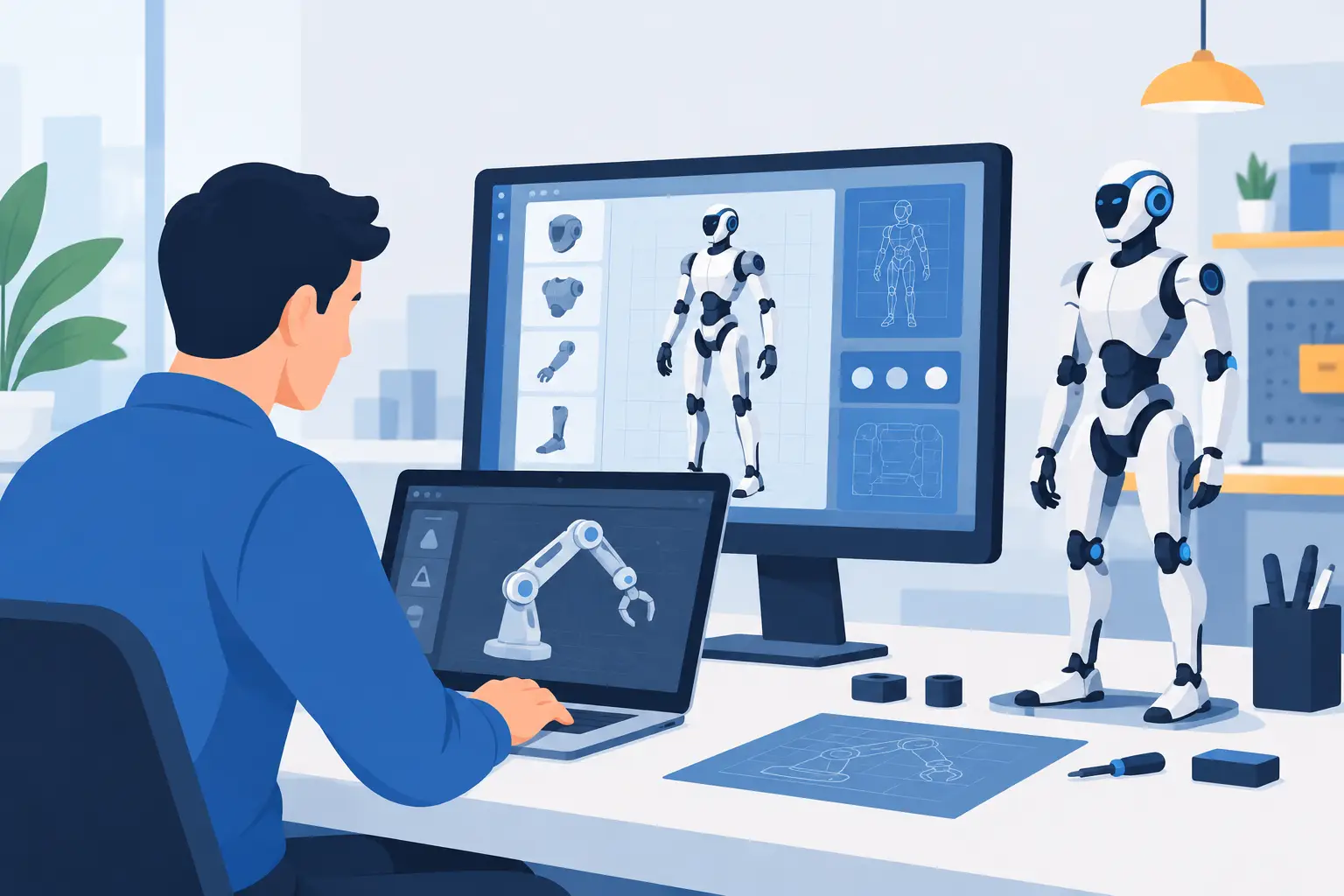
A robot idea rarely fails because it is not imaginative enough. It fails when the idea has to become a compatible circuit, a physical enclosure, a wiring plan, firmware, instructions, and a list of parts someone can actually buy. An AI robotics design platform changes that starting point: describe the product in plain English, then move toward build-ready technical outputs instead of a blank CAD file or a pile of disconnected tabs.
For a student building a classroom project, that may mean getting from “a robot that checks soil moisture and opens a greenhouse vent” to a workable parts list and assembly sequence. For an independent creator, it can mean testing whether a custom inspection robot is realistic before investing weeks in engineering. The value is not that AI replaces every engineering decision. The value is that it gives builders a structured first pass across the hardware, software, and documentation that a real robotics product requires.
What an AI Robotics Design Platform Should Produce
A useful platform does more than suggest a few components. It translates the job a robot must perform into connected design materials. If the controller, motor driver, power system, sensors, and mechanical parts are selected in isolation, the project can look complete on screen and still fail at the workbench.
Start with the concept. A clear prompt might describe the environment, movement, inputs, outputs, size limits, power source, and intended user. For example: “Create a compact tracked robot that carries a small camera through crawlspaces, streams video, and runs for 45 minutes on a rechargeable battery.” That description establishes constraints that should affect nearly every design choice.
From there, the platform should generate practical artifacts: an appropriate integrated-circuit and controller strategy, a robot design, wiring diagrams, step-by-step assembly instructions, starter code, and a bill of materials. Those outputs make the concept inspectable. You can see what is being proposed, question a component choice, identify a missing requirement, and prepare for a prototype.
That connected workflow matters because each artifact affects the others. A different motor may require a different driver. A higher-current driver may change the battery and wiring requirements. A smaller enclosure may force changes to connector placement, cooling, or service access. Good robotics development is a system problem, not a shopping exercise.
From Plain English to a Build Plan
The strongest workflow begins with the problem, not the part number. Before generating a design, define what success looks like. Does the robot need to lift, inspect, sort, measure, navigate, teach, or entertain? Where will it operate? What must it avoid? Is the goal a one-off learning build, a classroom kit, a functional proof of concept, or a product that can be sold?
Specificity improves the output. “Build a robot arm” leaves too much open. “Build a desktop robot arm that sorts three colors of small plastic parts, uses a camera, and can be assembled by high-school students in under two hours” gives the design process useful boundaries. It tells the platform to consider sensing, motion, safety, assembly difficulty, and cost.
Next, review the proposed architecture before ordering anything. Look at the relationship between the controller, sensors, actuators, power supply, and communications. Ask whether the system matches the job. A Wi-Fi-connected rover may suit indoor monitoring but be a poor choice for an area with unreliable network coverage. A high-torque actuator may solve a lifting problem while adding cost, weight, and battery demand.
Then inspect the wiring diagram as a builder, not just as a picture. Confirm voltage levels, ground connections, current paths, connector types, and the pins assigned to sensors and motors. Many early robotics failures come from issues that sound small: a servo powered from the wrong rail, a sensor that expects 3.3V logic connected to 5V, or a battery unable to supply peak motor current. A generated diagram gives you a place to catch those problems early.
The assembly instructions and starter code are where a concept begins to turn into a repeatable build. Instructions should help someone place components in order, route wires deliberately, test subsystems, and diagnose obvious errors. Starter code should establish the basic behavior - reading sensors, driving outputs, communicating with modules, or running a control loop - without pretending it is final production firmware.
The Deliverables That Reduce Prototype Friction
A bill of materials is often treated as an administrative detail. For builders, it is a design test. It reveals whether the project can be sourced at an acceptable price, whether parts are likely to be available, and whether the design depends on hard-to-replace components.
For educators, the bill of materials also determines whether a project can scale to a class. A design that works for one student but requires expensive tools, specialized soldering, or fragile components may not fit a 25-student lab. For entrepreneurs, the same list becomes an early view of unit economics. A compelling robot concept still needs a realistic material cost, assembly time, and procurement path.
Mechanical outputs deserve the same attention. A metal 3D-printable design may offer strength, durability, and a professional finish, but it changes the production equation. Metal printing can be more expensive and may require post-processing, tolerance checks, and design changes around fasteners or moving joints. Plastic printing may be better for quick iterations, while sheet metal or machined components may make more sense as volumes rise. The right choice depends on the robot’s loads, environment, target price, and expected quantity.
Documentation is another deliverable with real product value. A robot that only its original creator can assemble is difficult to teach, sell, support, or improve. Clear diagrams, organized parts lists, labeled connections, and tested build steps turn private knowledge into a kit others can use. That is the difference between a promising bench prototype and a project with a future.
Where Human Judgment Still Leads
AI can accelerate the first design pass, but it should not be treated as permission to skip testing. Generated designs need verification against datasheets, physical tolerances, electrical limits, local safety requirements, and the realities of available parts. If a robot moves near people, handles heat, carries loads, or uses high-current batteries, the review bar should be higher.
This is especially true for power and motion. Motors create noise, startup surges, and mechanical forces that can expose weak assumptions. A design may be electrically correct in principle yet need thicker wire, better grounding, a fuse, a different battery chemistry, or physical guards around moving parts. Build in stages: validate power first, then sensors, then motors, then integrated behavior.
Software also improves through real use. Starter code gets a robot moving, but field behavior may reveal timing issues, noisy sensor readings, calibration needs, or edge cases no prompt described. Treat the first build as an instrument for learning. Record what overheats, binds, drains too quickly, loses connection, or confuses users. Feed those findings back into the next version.
Build for the Next Person
The fastest path from concept to hardware is not always the shortest path to a dependable product. A simple design with common components, accessible fasteners, and understandable assembly steps can outperform a technically ambitious design that is difficult to reproduce. That trade-off matters whether you are teaching a lesson, preparing a science-fair build, launching a small kit business, or evaluating an early engineering concept.
Danon Robotica is built around this practical shift: turn a plain-English idea into the technical materials needed to build, teach, prototype, 3D-print, or sell a robotics product. The goal is not to make hardware development effortless. It is to put the essential engineering artifacts within reach earlier, when better decisions are cheaper.
Start with a problem worth solving, state the constraints plainly, and inspect every output like the builder who will have to make it work. That is how an idea becomes more than a robot concept. It becomes something another person can build with confidence.