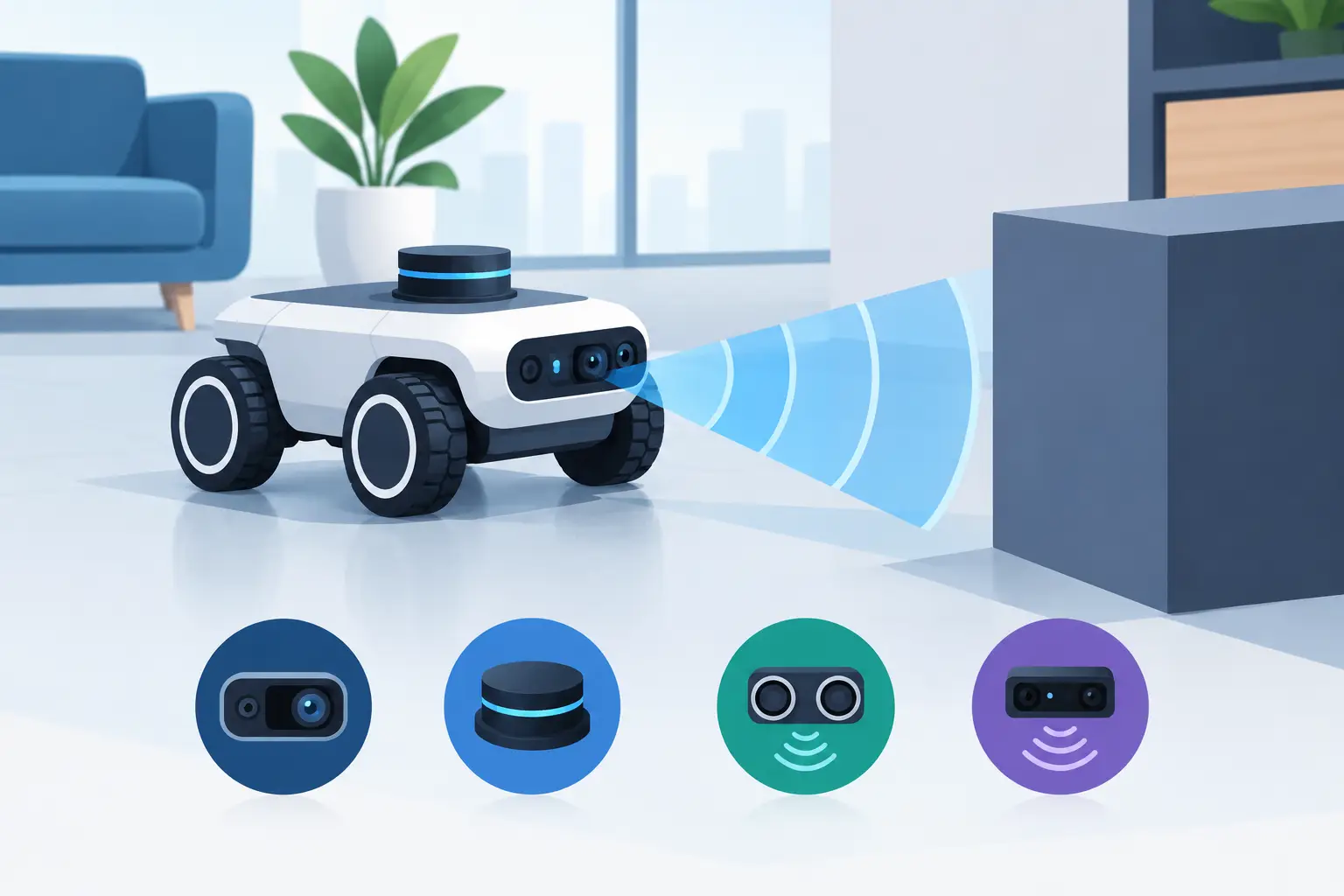
A robot can have clean wiring, strong motors, and polished 3D-printed parts, then still fail its first hallway test because it cannot see a chair leg. Choosing the best sensors for obstacle avoidance is less about finding one magic module and more about matching sensing physics to the space your robot must survive.
For a classroom rover, avoiding walls at walking speed may be enough. For an indoor delivery bot, it needs to detect dark furniture, glass doors, and people crossing its path. For an outdoor robot, sunlight, rain, dust, and long stopping distances change the design completely. Start with the motion, environment, and consequence of a missed object. Then choose a sensor stack your controller, battery, enclosure, and starter code can support.
What obstacle avoidance really needs to solve
Obstacle avoidance has three jobs: detect an object, estimate where it is, and act early enough to prevent contact. A sensor that detects a wall at 10 inches may be perfect for a slow desktop robot but insufficient for a fast cart that needs several feet to brake.
Range is only one variable. Field of view determines whether the sensor notices an obstacle off-center. Update rate affects how well it handles moving objects. Surface material matters too. Black fabric can absorb infrared light, angled foam can scatter ultrasonic sound, and clear glass can confuse some optical systems.
The practical question is not, "Which sensor is most accurate?" It is, "What can this robot reliably detect before its stopping distance runs out?" That framing prevents costly overdesign and helps you build a bill of materials around real requirements.
Best sensors for obstacle avoidance by robot type
Bump switches: the simplest safety layer
A bumper switch does not avoid an object before impact. It confirms that contact occurred. That sounds limited, but physical contact sensing is one of the most dependable and inexpensive ways to protect a small robot from getting stuck.
Use lever switches, whiskers, or a spring-loaded bumper along the front edge of a slow rover. When the bumper closes a digital input, the code can stop, reverse briefly, turn, and try a new direction. This method works in darkness and does not care whether an object is black, transparent, soft, or reflective.
The trade-off is obvious: the robot has already touched something. Bumpers are best as a backup layer beneath a non-contact sensor, not as the only system on a faster or more valuable machine.
Infrared proximity sensors: low-cost close-range detection
Infrared, or IR, proximity modules are a practical choice for compact indoor builds. Basic reflective sensors emit infrared light and measure what returns from a nearby surface. They are inexpensive, easy to wire, and often provide either a simple digital trigger or an analog output.
They work well for edge detection, close wall sensing, and small educational robots moving on predictable surfaces. A downward-facing IR sensor can also detect a table edge or line boundary before the robot drives off it.
Their weakness is material and lighting sensitivity. A matte black object may look farther away than it is. Bright sunlight can introduce interference. Many bargain modules have a rough adjustment potentiometer rather than a trustworthy distance measurement. Use them when you need a quick near-field decision, not precise navigation.
Ultrasonic sensors: a strong starting point for rovers
Ultrasonic ranging sensors send a sound pulse and measure the echo time. For hobby rovers and student projects, they remain one of the best value options for detecting walls, boxes, and people at short to medium range. They are easy to understand: trigger the sensor, time the echo, convert time to distance, and choose a motion response.
An ultrasonic sensor is especially useful when optical sensors struggle with dark objects. However, it is not immune to trouble. Soft fabrics absorb sound, narrow objects may be missed, and angled surfaces can send echoes away from the receiver. Temperature also slightly changes the speed of sound, which affects measurements.
If you mount several ultrasonic modules close together, do not trigger them at the same time. Their pulses can interfere with one another. Sequence measurements in code and allow echoes to clear. A servo-mounted module can scan left and right, but a fixed array often reacts faster because it does not wait for mechanical movement.
Time-of-flight sensors: compact and precise near-field vision
Time-of-flight, or ToF, sensors measure the travel time of emitted light. Unlike simple IR proximity modules, many ToF parts provide actual distance readings with useful repeatability over short ranges. They are excellent for compact robots that need reliable close obstacle detection, docking, wall following, or cliff sensing.
Most ToF modules communicate over I2C, which keeps wiring tidy but introduces a design detail: identical sensors often boot with the same I2C address. To use several on one bus, choose modules with shutdown pins and assign addresses during startup, or use an I2C multiplexer.
ToF sensors are a strong fit for indoor robots because they are small, fast, and easier to integrate than larger scanning systems. Their limits depend on the specific module, ambient light, target reflectivity, and maximum ranging mode. Read the datasheet rather than trusting a marketplace range claim.
LiDAR: better spatial awareness for autonomous movement
LiDAR measures distance with laser light. A single-point LiDAR sensor gives one highly useful range measurement, while a 2D scanning LiDAR creates a horizontal map of nearby objects. For robots navigating rooms, workshops, warehouses, or competition courses, a scanning unit can be a major step up from isolated distance sensors.
A 2D scanner helps the robot see open paths, corners, furniture legs, and approaching obstacles across a wide angle. It also supports mapping and localization workflows when paired with suitable compute hardware and software. This is where obstacle avoidance shifts from simple reactive behavior to planned motion.
The cost, size, power draw, and data-processing requirements are higher. LiDAR is often unnecessary on a small beginner rover. It becomes worthwhile when your product needs repeatable autonomous navigation or when a missed obstacle carries a higher cost than the sensor itself.
Cameras and depth cameras: useful when the robot must understand objects
A standard camera is not a distance sensor by itself, but computer vision can classify objects, detect lanes, read markers, or recognize a person. A depth camera adds distance data, making it useful for robots that must understand both what is present and where it is.
This approach demands more from the system: processing power, calibrated optics, carefully managed lighting, and more sophisticated code. A camera may identify a cardboard box, while LiDAR simply reports a shape at a location. That extra context is valuable for advanced projects, but it is not the fastest route to a collision-free first prototype.
Use cameras when visual recognition is part of the product requirement. Do not choose them solely because they look advanced. A well-placed ToF sensor can solve many close-range problems with far less hardware and software overhead.
Radar: the outdoor and all-weather specialist
Radar sensors use radio waves and can perform well in conditions that challenge cameras and optical ranging, including darkness, fog, dust, and light rain. They are especially relevant for outdoor mobile platforms, larger vehicles, and systems that need to detect motion at longer distances.
For small indoor kits, radar can be harder to interpret than ultrasonic or ToF data. Its field of view and reflections may make close object localization less intuitive. Still, it is a valuable addition when environmental resilience matters more than fine visual detail.
Build a sensor stack instead of betting on one device
The most capable robots combine complementary sensors. A practical indoor rover might use front-facing ToF sensors for immediate stopping, side sensors for wall clearance, and bumper switches as a last defense. A navigation-focused platform might add 2D LiDAR for route planning. An outdoor machine could pair radar with optical ranging rather than depending on either alone.
This layered approach also improves failure handling. If a sensor returns an impossible reading, such as zero distance or a value beyond its rated range, the controller should reject it, slow down, or request another reading. Add basic filtering, such as a rolling median of recent samples, so one noisy measurement does not cause erratic turns.
Sensor placement matters as much as sensor selection. Mount forward sensors at the height of the obstacles you care about. A sensor placed high on the chassis can miss low bins and table legs. Recessed sensors may have their view blocked by an enclosure lip. Test the finished mechanical assembly, not just the bare module on a breadboard.
Choose hardware that fits the rest of the design
Before ordering parts, check operating voltage, logic levels, current consumption, interface type, physical mounting, and library support. A 5V echo signal can damage a 3.3V microcontroller input without level shifting. I2C devices need compatible pull-up resistors and address planning. UART LiDAR modules need an available serial port or a deliberate software serial strategy.
Also design for the robot's decision speed. Measure its top speed and braking behavior, then create a conservative stop threshold. If the robot takes 12 inches to stop, triggering avoidance at 10 inches is not avoidance. Give the control system time to read the sensor, decide, command the motor driver, and slow the chassis.
Danon Robotica can help turn those requirements into a compatible design package, from integrated circuit choices and wiring diagrams to starter code, assembly steps, and a bill of materials. Describe the robot's environment, size, target speed, and obstacle types in plain English so the design starts with the job the sensor must do.
Build your first avoidance system around a simple test course: a wall, a dark object, a soft object, a narrow chair leg, and a clear or reflective surface. The sensor that performs well across your actual course, with your final motor speed and enclosure, is the one that earns its place on the robot.