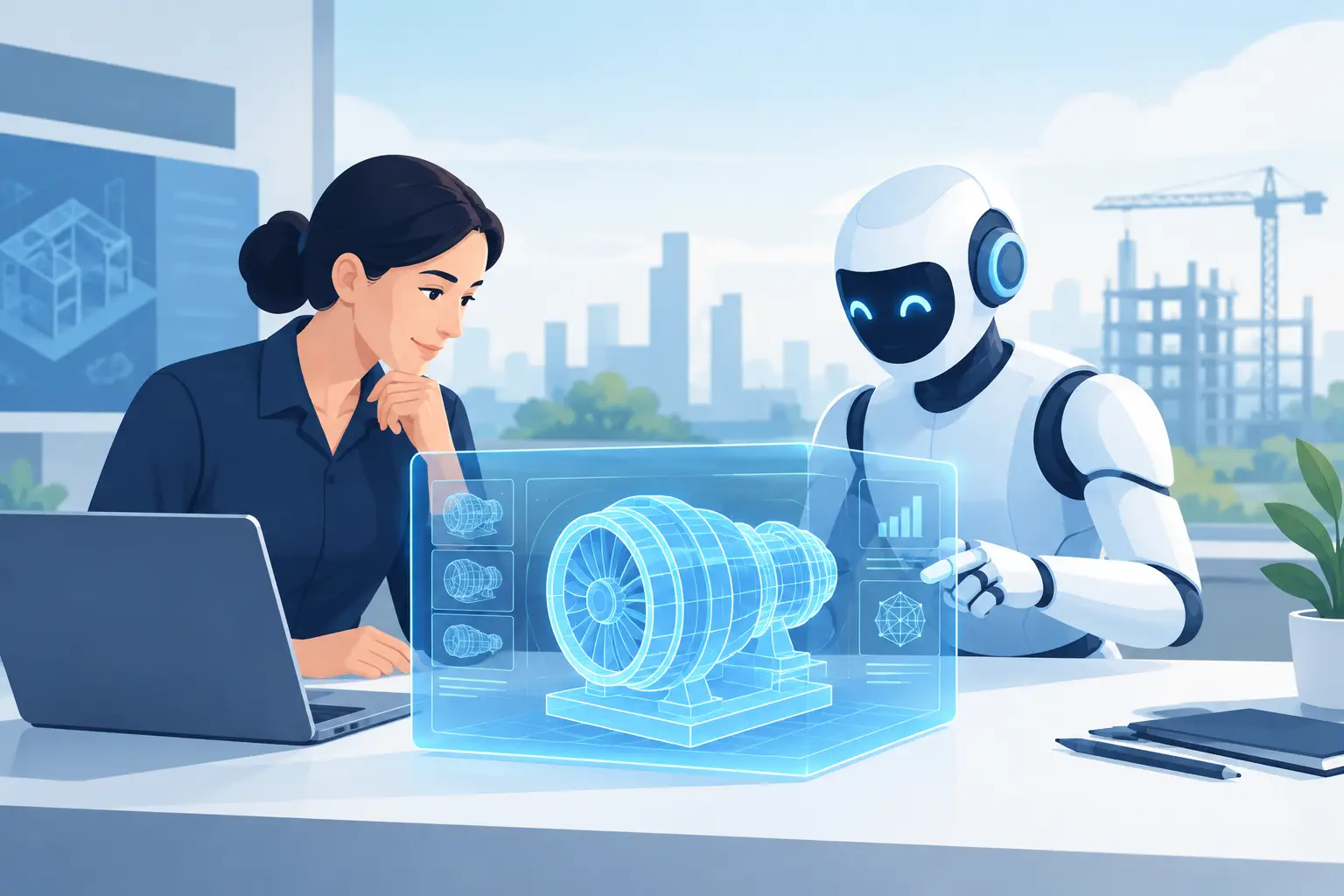
A student sketches a warehouse robot on a notebook page. A maker describes a camera rig that follows a moving subject. A small hardware team needs a prototype for a customer meeting next week. The future of AI assisted engineering is about turning each of those starting points into concrete technical work: selected components, wiring diagrams, mechanical plans, starter code, assembly instructions, and a bill of materials.
That change matters because robotics projects rarely fail for lack of imagination. They stall when the idea has to cross too many technical boundaries at once. A motor choice affects the driver, power system, enclosure size, code libraries, heat management, cost, and supply availability. AI can help builders move through those connected decisions faster, but it does not remove the need to build, test, measure, and improve.
The Future of AI Assisted Engineering Starts With Intent
Traditional engineering tools begin after someone has already defined much of the solution. You create a schematic after choosing an architecture. You model a part after deciding its dimensions. You write firmware after selecting a microcontroller and sensors. These tools are essential, but they assume that the user knows where to begin.
AI-assisted engineering changes the front door. A builder can start with intent: “I want a compact robot that carries tools across a workshop,” or “I need a classroom rover students can assemble and program.” The system can translate that plain-English brief into a first-pass design package, including suitable integrated circuits, motors, sensors, power requirements, and physical structure.
This is not the same as asking AI for a quick answer in a chat window. Useful engineering output has to connect decisions. If a design specifies a higher-torque motor, the wiring, motor driver, battery capacity, mounting hardware, and thermal limits need to reflect that choice. The value comes from coordinated artifacts, not a paragraph of generic recommendations.
For builders, the result is a shorter distance between an idea and something testable on a bench. For educators, it creates a clearer way to show how mechanical, electrical, and software decisions work together. For small product teams, it can make early exploration less expensive and less dependent on a long chain of disconnected tools.
From Prompt to Build Package
The strongest AI engineering workflows will be judged by what they produce after the prompt. A concept is only useful when it becomes buildable.
A practical output begins with an understandable specification. It should define what the robot does, its operating environment, movement method, payload, approximate size, controls, and power source. From there, AI can propose an electronics architecture that connects the controller, sensors, actuators, communication modules, and protection components.
Next comes the documentation that lets another person actually make the device. Wiring diagrams reduce ambiguity at the workbench. A bill of materials turns a concept into a purchasing plan. Step-by-step assembly instructions help a student, technician, or customer reproduce the build. Starter code gives the hardware a working baseline rather than leaving the builder with a powered board and a blank editor.
Mechanical output matters just as much. An enclosure that looks good but blocks a cable path, traps heat around a driver, or cannot be printed within the available build volume is not production-ready. AI can accelerate part design and generate fabrication-ready models, including parts intended for metal 3D printing, but material choice, tolerances, fasteners, loads, and finish requirements still need validation.
This is where an integrated platform such as Danon Robotica points to a more useful model. Instead of treating chip selection, wiring, CAD, code, and documentation as separate handoffs, the workflow can keep them connected from the initial description through the first physical build.
AI Makes Engineering More Accessible, Not Automatic
There is a real difference between lowering the barrier to entry and pretending that engineering has no constraints. A plain-English interface can make robotics more approachable for a high-school student or first-time product creator. It can also save experienced engineers hours of repetitive setup work. Neither outcome means that the physical world has become forgiving.
A generated wiring diagram may be logically correct and still need review for wire gauge, connector orientation, noise, grounding, fuse placement, current draw, or available PCB space. Starter code may control a motor on a development board but require tuning before a real robot moves safely under load. A parts list may need substitutions when prices change or a component goes out of stock.
The right mindset is co-engineering. AI handles much of the translation, organization, and first-pass generation. The human defines the goal, supplies the context, checks assumptions, and makes the trade-offs that depend on the real use case.
Consider a delivery robot designed for an indoor office. A low-cost plastic chassis and small battery may be sensible. Move the same design to a factory floor, and dust, impacts, slopes, runtime, wheel traction, and safety requirements change the engineering problem. AI can surface those questions early, but the builder must answer them.
Better Prototypes Mean Better Questions
One of the overlooked benefits of AI-assisted engineering is that it improves the questions people can ask sooner. When a concept becomes a wiring diagram, an assembly plan, and starter firmware in a short time, weak assumptions become visible.
Can the selected battery support the motors at peak load? Will the sensor still work in bright sunlight? Can the enclosure be assembled without trapping a connector inside? Is this kit simple enough for a classroom session? Is the per-unit cost low enough to sell?
Those are productive questions because they are specific. They move a project beyond “Could this robot exist?” toward “What would it take to make this robot reliable, teachable, manufacturable, and worth building?”
For entrepreneurs, that means faster learning before committing to inventory or custom tooling. A creator can produce a functional prototype, show it to potential customers, and revise the design based on real feedback. For instructors, students can spend more time understanding systems and testing hypotheses rather than losing an entire project cycle to missing documentation. For professional engineers, AI can rapidly generate design alternatives worth reviewing before the team commits to one path.
The Engineering Skills That Will Matter More
As AI takes on more repetitive design work, the most valuable human skills shift upward. Builders will need to frame clear requirements, spot unsafe assumptions, evaluate trade-offs, and test against reality. They will also need enough technical literacy to know when a generated answer needs closer inspection.
That does not make fundamentals less relevant. It makes them more useful. Understanding voltage, current, torque, tolerances, control loops, and material behavior helps a builder direct AI with precision and judge its output with confidence. The person who understands the system can iterate faster than the person who accepts every recommendation without question.
Communication becomes an engineering skill, too. A clear project description produces better results than a vague one. Define the robot’s job, environment, size, payload, budget, expected runtime, fabrication method, and intended user. The more meaningful context you provide, the less the system has to guess.
What Responsible AI-Assisted Engineering Looks Like
Speed should not outrun verification. Any design involving batteries, high current, moving mechanisms, heat, sharp edges, or public use needs appropriate testing and safeguards. A generated design is a starting point, not a certification, safety review, or guarantee that a device is ready for sale.
Responsible workflows include simulation where it helps, bench testing before full assembly, and staged tests before deploying a robot around people. Builders should inspect component datasheets, confirm electrical ratings, test fail-safe behavior, and document changes made during prototyping. If a product enters a regulated category or operates in a safety-critical setting, qualified review is necessary.
There are also practical limits around manufacturability. A one-off prototype can use hand-soldered connections and readily available parts. A sellable kit needs repeatable assembly, understandable instructions, substitute-part planning, packaging, quality checks, and support for the person who buys it. AI can prepare much of that documentation, but real production discipline remains a human responsibility.
The next generation of engineering builders will not wait for a perfect idea or a perfect skill set. They will describe the problem clearly, generate a build package, test the first version, and let the physical result teach them what to improve next.