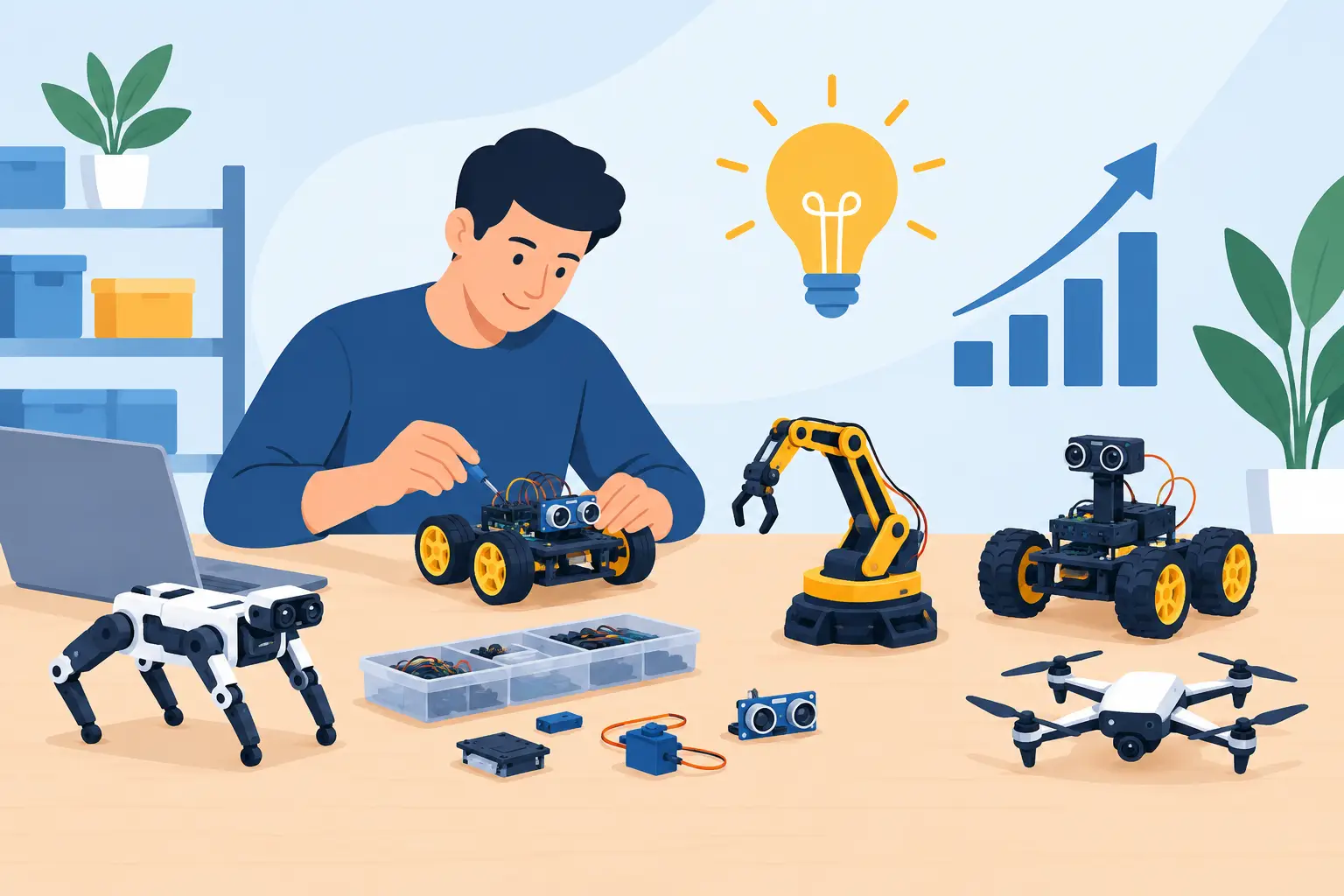
A robotics kit does not need to compete with a giant consumer toy brand to become a real business. A focused kit that solves one clear problem - helping students learn sensor logic, enabling growers to monitor a greenhouse, or letting artists build kinetic displays - can have a more credible path to sales than a general-purpose robot box. The best robotics kit business ideas start with a specific buyer, a build they can complete, and an outcome they can show.
The opportunity is not only in the electronics. Buyers pay for a well-chosen set of parts, understandable wiring diagrams, reliable starter code, assembly instructions, and a project that feels worth finishing. That is where a custom kit can outperform a pile of components.
What Makes a Robotics Kit Worth Buying?
A sellable kit removes uncertainty. The customer should know what they are building, why the parts work together, how long it will take, and what success looks like. If they need to research compatible integrated circuits, guess at motor-driver wiring, or hunt for missing hardware, the kit is unfinished from their perspective.
Start by defining the kit in one sentence: “This kit helps middle-school students build a robot that avoids obstacles,” or “This kit lets small farms automate irrigation measurements.” That sentence establishes the audience, job, and level of complexity.
A strong first product is usually narrow. It uses readily available parts, has a limited number of assembly steps, and supports one or two useful variations rather than ten half-tested features. More features can raise the bill of materials, increase support requests, and make classroom setup harder. The right scope depends on whether you are selling to beginners, educators, hobbyists, or professional prototypers.
9 Robotics Kit Business Ideas for Focused Markets
1. Classroom Sensor Lab Kits
Build a kit around core inputs and outputs: light, distance, temperature, motion, LEDs, a buzzer, and a small display. Students can wire sensors, read data, and program simple responses without needing a full mobile robot.
This is a practical fit for educators because one platform can support multiple lessons. The business value comes from the teaching sequence as much as the hardware. Include labeled components, classroom-ready assembly steps, starter code for each experiment, and a teacher guide that explains expected results and common mistakes.
2. Line-Following Robot Kits for Competitions
Line-following robots are familiar, but there is room for a better-defined kit. Aim at a particular age group or competition format. Offer a basic version for first-time builders and an expansion path with adjustable sensors, faster motors, or a chassis designed for tuning.
The differentiator is documentation that explains calibration. Builders need to understand sensor position, surface contrast, motor differences, and speed trade-offs. A kit that merely works on one sample track will create frustration. A kit that teaches users how to troubleshoot on their own earns repeat customers.
3. Assistive Device Prototype Kits
Create modular kits for simple assistive technology concepts, such as reminder devices, switch-controlled tools, posture alerts, or environmental controls. This category requires care: do not position a prototype as a medical device or promise health outcomes without the appropriate testing and regulatory work.
The safer and more useful angle is an educational or prototyping kit for students, makerspaces, occupational therapy programs, and design teams. Focus on adjustable switches, accessible enclosures, large indicators, and configurable code. The buyer is often paying for a platform that helps them test an idea quickly with a real user.
4. Greenhouse and Garden Automation Kits
A small automation kit can measure soil moisture, temperature, humidity, light levels, or water reservoir levels. It can trigger a pump, fan, or alert based on rules set by the user. This idea serves home gardeners, school garden programs, urban farming groups, and STEM clubs.
Keep the first version honest about its environment. Indoor seedling monitoring is easier than outdoor, weatherproof irrigation control. If your kit includes water handling, specify power requirements, tubing limits, enclosure needs, and safe setup practices. The product becomes more valuable when it shows users the data and lets them understand why an action occurred.
5. Kinetic Art and Interactive Display Kits
Artists and museum educators often want movement, light, sound, and sensor input without starting from a blank breadboard. A kinetic art kit might control servos, stepper motors, LEDs, and proximity sensors through simple programming examples.
This is one of the more creative robotics kit business ideas because the finished outcome is highly shareable. Design the electronics around a visible project such as a moving sculpture, reactive wall panel, or programmable desk display. Make the mechanical build flexible enough for users to replace the included materials with their own cardboard, wood, acrylic, or metal 3D-printed parts.
6. Robotics Kits for Inspecting Tight Spaces
A compact rover with a camera, lights, and remote controls can serve educational demonstrations, hobby exploration, and early prototype work. Potential users include makers interested in crawlspaces, model environments, ducts, and small-scale inspection challenges.
Avoid overstating capabilities. A low-cost rover may be useful for learning and light observation but not for hazardous, industrial, or safety-critical inspections. Your product can still stand out with a durable chassis, clear wire routing, replaceable drive modules, and starter code for streaming video or controlling movement.
7. Warehouse and Logistics Simulation Kits
Build a tabletop robot kit that follows routes, identifies markers, carries a small payload, and demonstrates sorting logic. It gives students and training groups a physical way to explore automation concepts used in logistics operations.
The customer is not buying a miniature warehouse. They are buying a hands-on lesson in sensing, navigation, motor control, and workflow design. Add printable route layouts and programming challenges that progress from basic movement to barcode-like marker recognition or task scheduling. This can work especially well for college courses and workforce programs.
8. Pet Enrichment and Training Devices
A kit that dispenses a treat, moves a toy, or responds to a button press can appeal to pet owners who enjoy building. The product must prioritize safety: enclosed moving parts, stable construction, low-voltage power, chew-resistant considerations, and clear guidance that pets should be supervised.
This niche benefits from a strong physical design. A loose electronics project is not a consumer-ready pet product. Consider a kit that lets users build the controller and customize routines while using a protected enclosure and purpose-built mechanical components. It is a more demanding product to develop, but it can create a distinct brand category.
9. Metal 3D-Printable Robotics Chassis Kits
Some advanced makers and engineering teams want to move beyond plastic frames. A business can sell designs and hardware packages for modular brackets, grippers, rover frames, or sensor mounts intended for metal 3D printing.
This model requires precise tolerances, fastener specifications, and realistic manufacturing guidance. Metal printing offers strength and durability, but it raises cost and may require post-processing. Target buyers who understand those trade-offs and need a custom fixture, specialized mount, or small-batch mechanism rather than a low-cost beginner project.
Turn a Concept Into a Kit People Can Build
Before buying inventory, create a complete prototype package. You need more than a working device on your desk. Build the exact experience a customer will receive: the bill of materials, mechanical parts, wiring diagram, assembly sequence, starter code, packaging list, and troubleshooting notes.
This process exposes the expensive problems early. Maybe a sensor conflicts with the selected microcontroller voltage. Maybe a motor demands more current than the driver can safely provide. Maybe one screw is inaccessible after the enclosure closes. Maybe a beginner needs a pre-crimped connector instead of a soldered joint. Each discovery improves the product before it becomes a customer support ticket.
Danon Robotica can shorten this development stage by turning a plain-English product idea into integrated circuit recommendations, robot designs, wiring diagrams, assembly instructions, starter code, and a full bill of materials. That gives a builder a practical starting point, but it does not replace real prototype testing. Assemble the kit yourself, then have someone from the intended audience build it using only your documentation.
Choose a Sales Model That Matches the Product
Your sales model should follow the buyer's needs. A one-time hobby kit works when the project itself is the reward. Classroom kits may need educator packs, replacement components, and lesson materials. Advanced chassis designs may be better sold as digital plans paired with a hardware pack, because customers may source or print specialized parts locally.
Price from the full delivered experience, not just the component cost. Include packaging, payment fees, fulfillment, returns, replacements, instructions, testing time, and customer support. A kit with a low parts cost can still lose money if every buyer needs an hour of troubleshooting help.
The strongest early signal is not a large social following. It is a small group of buyers who complete the project, understand it, and ask what they can build next. Start with a kit narrow enough to finish well, document every step as if someone else will teach it, and let the first successful builds point to your next product.